Tuesday, June 15, 2021

Weary (and wary) of change

There are at least two sorts of changes, perhaps more. The first sort is the type of change that life brings about, that you can do nothing about--innate change. We age, we grow older, we grow old. There are many changes connected to aging that we can merely observe in ourselves and others; we cannot stop the progression of time. Illness and death are part of the journey. We learn to accept this type of change, albeit grudgingly at times, mostly because there is nothing we can really do about it. At some point you realize that it's best not to think too much about it and to enjoy the days and years that are given you. Because not all people get that chance, as has become all too clear to me during the past decade. 

The other type of change is external change. It is not a natural part of human life as is innate change, but it is a part of our lives that has consequences for us. It is often a type of change that can be forced upon you by a workplace or an organization, or by events in one's personal life that you have not instigated. It can be unsettling change, in that you have to react to it in one form or another, either passively or actively. Many choose the passive route, others choose the proactive route. Regardless, this type of change will affect your life and change it irrevocably--marriage, children, divorce, a major move, a bad job, a good job, retirement. They are changes we can choose, but sometimes they are not. And it is when this type of change is forced upon us that problems can arise. 

During the past two decades or so, modern workplaces have put a tremendous amount of emphasis on the necessity for employees to be able to change (almost at a moment's notice). I remember when I took a year-long leadership course here in Oslo; the operative (Norwegian/Danish) word was 'endringsparat' (ready for change). As a leader, it was important that your employees were endringsparat. An entire module was dedicated to how to lead employees through major workplace changes, and how to deal with those employees who were resistant to change. It was an interesting module, to say the least. Discussions of major mergers came up, and our teacher took an informal poll of the class--how many had been through such a major change as a merger and felt that the outcome was successful. Only one or two people raised their hands. The majority did not, and when quizzed, told stories of fiascos and failures to communicate that torpedoed such workplace changes. There was massive resistance to the changes that ensued in the wake of the merger. What was not commented upon or discussed was the timescale involved in such major changes. How quickly do leaders expect employees to adapt to change? Mergers, for example, are such major changes that it wouldn't surprise me if it took a decade or more for employees to become used to the idea. I don't think most leaders look at this aspect--the length of time involved for employees to adapt to and to accept change. I think they should look more closely at exactly this aspect. 

It is possible for employees to become weary and wary of change. Just hearing the word 'change' can be anathema for some employees, and I think that's because they feel that they have had no say in the matter. Yet another change has been forced on them, that they are expected to accept immediately. That can only lead to conflicts and failure to communicate. I think the time window for measuring the outcome of change should be long. I think management should allow at least five to ten years for employees to adapt to major changes. But that is rarely the case. It all has to be wrapped up nicely with a pretty bow, so the package can be displayed as a 'success'. But how do you measure that success? Did you talk to your employees?

I know several leaders who are young (in their forties) and older (around sixty or in their sixties). All of them have faced situations of major change that they have had to implement or are responsible for initiating. All of them have expressed mild to strong surprise that many of their employees appear to be resistant to those changes. They don't get it, they don't understand what they've done wrong. I try to tell them that perhaps their employees are weary of change. And that some are most likely wary of change. I was, during a period of too many changes about fifteen years ago. I listened to the svada (empty words, empty phrases, meaningless talk about great ambitions for this and that) and thought 'been there, done that'. So many times I can't count. How many times can you change yourself, start over, reinvent yourself, market yourself and your dreams, and to what end? Are we all to conquer the world? Most of us are good at what we do, and that should be enough. But in today's modern workplace, it's not, at least not for many modern workplace leaders. They have to do something, they have to effect change, they have to be remembered for such things. They have to 'motivate' their employees and make them endringsparat. It borders on hysterical. I prefer the non-hysterical approach. 

Through all the years, there has been change, whether modern leaders see it or not. Workplaces change, not because of artificial changes forced on employees, but because the world around us changes. We communicate via internet and digital meetings because technology in the world has made it possible for us to do so. That changes a workplace. Emails changed workplaces for good. They also changed personal communication for good. Smart phones likewise. IT departments are large and necessary entities in most companies; just try living without your computer when it's down for two days. So changes have been implemented gradually over the years in response to the external world. It is the artificial changes, the forced and often unnecessary changes, that cause problems. Leaders who are truly interested in the wellbeing of their employees should learn to distinguish between what are necessary and what are unnecessary changes. The latter can wear down the morale and motivation of many employees, whether modern leaders like it or not. 


Saturday, June 12, 2021

The garden in June

It's been a while since I've posted photos of my garden. It got a slow start this year due to a very rainy and chilly May. About the only plants that loved the rain were the strawberry plants; I've never seen them so tall as they are this year. But since June started, the weather has been warm, with temperatures in the mid-70s, and most of the days have been sunny. We've had very little rain so far in June. So now the plants are taking off, and I hope there will be a good yield of zucchinis, butternut squashes, and pumpkins. The potato plants (two types) are doing well; they are also quite tall already. I planted the tomato plants in the same area as last year, since it gets a lot of sun. They did well last year, so I'm hoping for a repeat success. I have a few bean plants that are just sprouting, some onion plants, and two cucumber plants. Most of my perennials came back after winter, but not all. We did not have a lot of snow this past winter, mostly cold temperatures and frost, and that does a lot of the perennials in. Snow actually protects the roots of perennials by keeping them insulated. I'll have to remember to cover the plants with mulch/dead leaves in order to protect them for next winter's cold temperatures. 

My lilac bush, wisteria tree, magnolia tree, potentilla (cinquefoil) bushes, and my ninebark bush all survived the winter and are doing well. The wisteria (planted two years ago) has even produced two purplish-blue flowers, which surprised me because I remember reading that it can take three to five year for wisteria to bloom for the first time. But it's in a part of the garden that gets full afternoon sun, and that part of the garden is less open/more protected. That could have something to do with it. I planted two forsythia bushes around mid-May, and they have just taken off. I love forsythia; it reminds me of childhood when we would pick forsythia that grew wild and put it in a vase when we got home. My autumn aster is also very happy. I got some Columbine plants from a garden neighbor, and some hollyhock seedlings from the neighbor across the street from the garden. Both are growing well. Otherwise, I've planted sweet pea flowers and one cathedral bell (Cobaea scandens) plant. 

My peony plants will have a lot of flowers this year. My Japanese maple tree has also grown taller, and is so pretty. My rose bush and my climbing roses have produced new stems that are growing taller each day. The irises, which are such elegant and beautiful flowers, are starting to bloom. All the berry bushes have produced berries that are starting to ripen. We will get a lot of strawberries, black currants, and gooseberries this year. It will be interesting to see if we get a lot of raspberries, blueberries, and red currants. 

I bought two new Coral bells plants to replace the two that died after the winter cold. And then there are the pansies, which are such great little flowering plants. They do well in most types of soil and tolerate most temperatures and weather that the Norwegian climate tosses at them. 

So the garden is blooming, and it always does my heart good to see that. It is a reward for all the hard work that goes into a garden. It makes me feel good to know that I've learned enough to know how to care for my plants. I cannot control how tough winter is on my perennials, but I do my best to prepare them for winter. The rest is out of my hands. 

Wisteria bloom

Wisteria tree


Magnolia tree

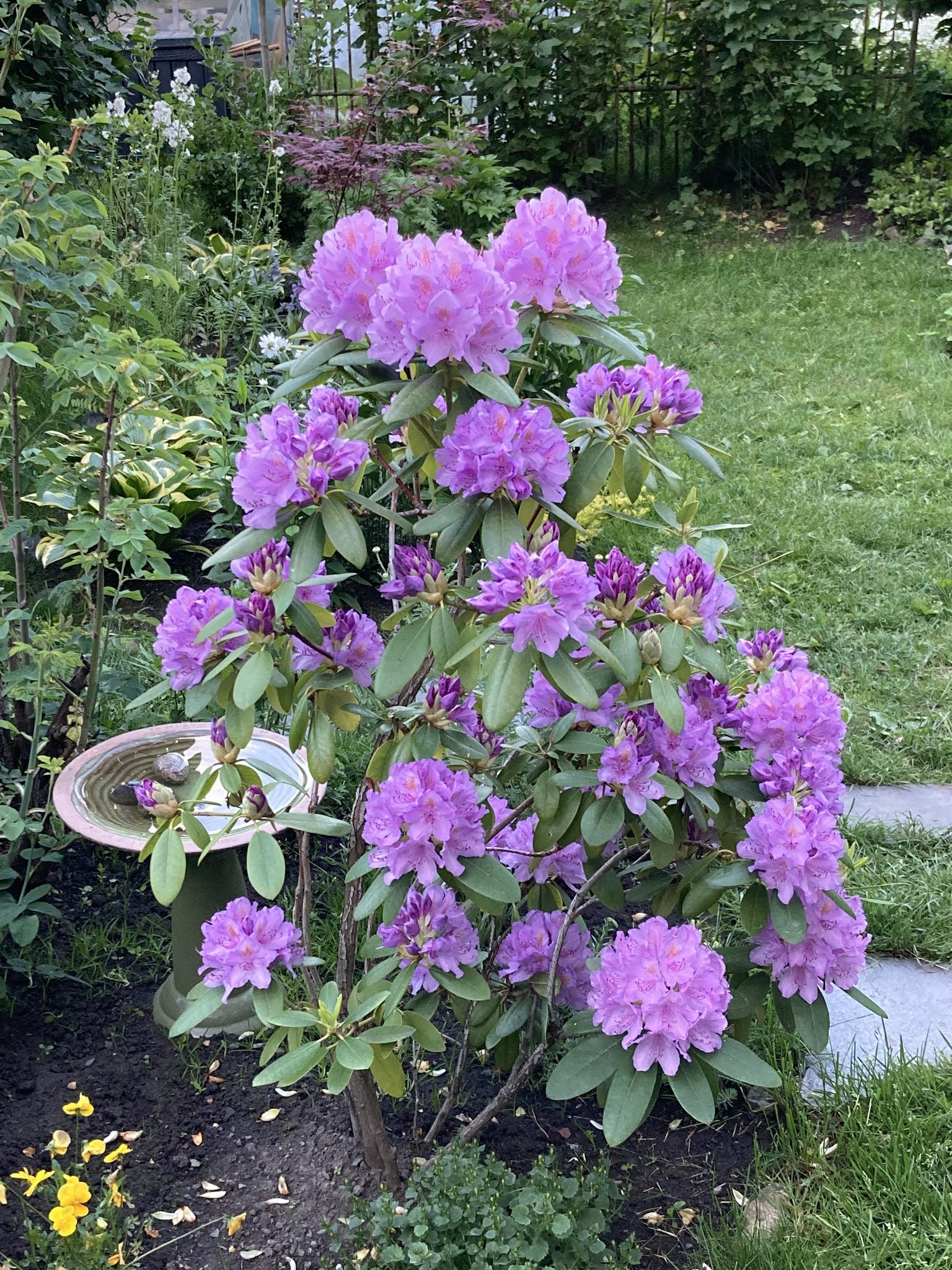
Rhododendron bush--so many blooms this year


Beautiful irises

Snapdragon plant


Potato plants growing


Strawberry plants--two patches


behind the greenhouse 


Bumblebee on rhododendron flower

Honeybee on flower


Saturday, June 5, 2021

A leap into the unknown

And so I've taken the next step and a leap into the unknown--in September I will join the ranks of those who have retired early. I've thought long and hard about this decision and have planned well for it, as one of my leaders commented. I have. My responsibilities for research projects and PhD/Masters students are fulfilled; my last PhD student defended her thesis in April. I could go in another direction now and start to study another type of cancer (my focus has been colorectal cancer for my entire academic career), but I don't want to switch fields and there is no more funding to be obtained for my particular research area. I'm proud of the work I've done. I've published nearly one hundred research articles as a main author/co-author and have been a mentor/co-mentor for three Masters students and six PhD students, all of whom successfully finished their degrees. What I've learned after many years in academia is that an academic career is demanding; one must be good at grant-writing, article-writing, mentorship, project planning and execution, networking, academic politics, communication, and diplomacy. I was good at most of it, but not at academic politics and as it evolved, grant-writing. But to be fair, the world of research science changed dramatically compared to when I started out in the mid-1990s. It was easier to write grants and get them funded then. I prefer the way research was done then--in smaller research groups without an emphasis on centers of excellence and platform-based research. I am old-school and do not apologize for it. I do not fit together with big research groups and large research centers, nor am I interested in having to follow a center leader's plan for what type of research project I should focus on. As a senior scientist, I feel that this decision should be left up to me, but often it's not. I've written about all of this before, about how postdocs are used as technicians in large research groups, going from one postdoc position to another and using valuable time trying to please group leaders instead of the group leaders encouraging them to become independent scientists. I would go so far as to say that many group leaders use postdocs as slaves; they know they will get a lot of work out of them, but they don't have to worry about rewarding them in any way. It's unfair, and that's just the way it is. There are scientist associations (unions) working on the problem, but so far it remains that--a problem. 

I won't miss the work world. Either it moved away from me, or I grew beyond it. I grew to want more than it could give me. I used to get really jazzed at the idea of scientific meetings and conferences; I no longer do. It's more a 'been there done that' type of feeling. And I could write a long post about academic politics--how bored I am with them; the truth is that you are either on the current ruling team or you're not. If you're not, you're not important, and that means that your expertise is mostly ignored in favor of someone else who just happens to be on the right political side. And so it goes. Life is not fair, and academic life is definitely not fair. It's who you know, not what you know. I think it's always been that way, and that it will continue to be that way. I also won't miss the feeling of constantly having to do homework--read articles, stay updated, read more articles, plan more research. It's tiring. 

Now that I've informed my leaders, I feel free. I've been walking around for the past year with this decision on my shoulders, so to speak. Should I or shouldn't I? As it turned out, there are personal reasons for why I made the decision now. I won't detail them here, but it has to do with that life is short and that friendships mean more than work. So in a sense, the decision was easy to make. I want to spend more time with friends, not more time at the office. 

Leaving the work world is a leap into the unknown. I look forward to finding out what the next life chapter holds. I don't need to know everything that's going to happen, nor do I want any major plans or responsibilities hanging over me. I want at least one year without any plans or responsibilities. After that, we'll see. One thing is for sure; I will be able to focus on my writing a lot more. It will be nice to have the time to do that, when I want to do it. And if you want to find me most days during spring, summer, and fall, you'll find me in my garden. 


Wednesday, May 26, 2021

The quest for fame (and fortune)

Apropos my post the other day about anonymity and those who spend their lives in a quest for fame and fortune--here is a rather apt cartoon from one of my favorite comic strips, Non Sequitur by Wiley Miller.


Sunday, May 23, 2021

The Undisputed Truth - Smiling Faces Sometimes (1971)


An oldie but goodie. The video is so-so, but the song is so good--and relevant for the times we live in. A warning, a message, good advice. The songwriters knew the truth--smiling faces are not always what they seem to be. Here are the lyrics: 

Smiling faces sometimes pretend to be your friend.
Smiling faces show no traces of the evil that lurks within.

Smiling faces, Smiling Faces, Sometimes they don't tell the truth.
Smiling faces, smiling faces tell lies and I got proof.

The truth is in the eye 'cause the eyes don't lie, amen.
Remember, a smile is just a frown turned upside down my friend.
So, hear me when I'm saying

Smiling faces, Smiling Faces, Sometimes they don't tell the truth.
Smiling faces, smiling faces tell lies and I got proof.

Beware. Beware of the handshake that hides the snake,
I'm tellin' you beware of the pat on the back it just might hold you back.
Jealousy, (Jealousy) misery, (misery) envy.
I tell you you can't see behind

Smiling faces, Smiling Faces, Sometimes they don't tell the truth.
Smiling faces, smiling faces tell lies and I got proof.

Your enemy won't do you no harm, 'cause you'll know where he's comin' from;
don't let the handshake and the smile fool ya.
Take my advice I'm only tryin' to school ya.

Smiling faces, Smiling Faces, Sometimes they don't tell the truth.


Source: LyricFind
Songwriters: Barrett Strong / Norman Whitfield
Smiling Faces Sometimes lyrics © Sony/ATV Music Publishing LLC, DistroKid


Monday, May 17, 2021

Reflections on anonymity

Most of us will never become famous for what we do or for who we are, and most of us are satisfied with that, because we did not set out to become famous. We did not set out to become world conquerors, famous for what we do, or filthy rich because of what we do. Most of us did the best job we could do in our chosen field, achieved a modicum of success, enjoyed decent incomes, and made sure that those who follow us were ready to take over for us when it was our turn to leave that field behind. Anonymity is not something we chose, it simply is the backdrop of our lives while we live them. We are not anonymous to those we love and who love us. We choose to give up anonymity in order to love another person. But we remain otherwise anonymous to the world at large. 

Most people don't seek widespread attention willingly, because the idea of being center stage is not appealing. That is true for me as well. It has happened that we found ourselves center stage at several points in life, but those were not aimed-for experiences, rather stressful ones, especially for introverts or ambiverts with introvert tendencies. When I was in grade school and high school, I was deemed the smartest student in my class each year based on grades, and that meant accepting several honors at the end of each school year. While it was nice to be recognized, it also meant accepting awards in public and feeling pressure to accept a position as student council president in high school, a position for which I was unsuited and which I disliked immensely. Being the top student also meant holding a valedictorian speech at the end of high school for a huge auditorium of people that made me nervous for weeks prior to graduation. That has been the case for every single speech or lecture I have given since then. I've agonized for weeks about them--what to say, how to say it, will it be well-received, will I make a fool of myself, will I be so nervous that I couldn't enunciate correctly, and so on. I have never enjoyed public speaking nor being on stage. I remember performing in dance recitals, and how nervous I was before each recital. But I loved dancing and dancing classes, and recitals were a part of the entire experience. For me they were just something to get through. 

As I've gotten older, I've realized that preparation is key; if you practiced your speech enough times, or memorized your lines, or your dance moves, you would be fine. Something automatic takes over when you finally step onto the stage and it's your turn to be in the spotlight. With one exception, I've never made a bad speech, given a poor lecture, or performed a suboptimal dance. But my nervousness has not abated with the years. If being recognized and remaining anonymous were possible, that would be preferable. Writing comes closest to that combination; it is possible to write, to receive responses from readers, and to remain anonymous, at least in a general sense. I remember when my book about passive-aggressive leadership began to garner some attention; I was pleased but at the same time nervous when I read the reviews of the book. Putting yourself out there as a writer is an iffy proposition; will you be able to write and still retain a sense of anonymity? If one writes under a pseudonym, it is possible. The author who writes under the pseudonym Elena Ferrante has retained her anonymity while being a best-selling author, one example of this being possible. Her publisher protects her anonymity. 

Some people I know have never had a problem being in the limelight. They enjoy giving speeches, enjoy being the center of attention, and enjoy an audience, both socially and professionally. Most of them are extroverts. I admire them, at the same time knowing full well that I could never be like them, nor would I want to be. I am perfectly happy remaining out of the limelight, as long as I am recognized for the work I actually do and am rewarded for that when it comes time. That is very important, especially in a world that rewards extroverts for nearly everything. If you are comfortable in the limelight, if you don't mind selling yourself, if you like giving speeches or leading meetings, more power to you. But that shouldn't mean that those who don't like these things should not be rewarded. Unfortunately, if you are not an extrovert, you are often overseen in a work context. I have gone out of my way during my career to 'see' those employees who don't make a big deal about themselves, who prefer being in the background. I've always found them to be as smart and knowledgeable as the extroverts who have also been smart people, just more verbal about it. 

Some of you may be thinking that I am equating introversion and anonymity. I am not. But I have often found that introverts prefer remaining anonymous in the general sense of the word--unidentified, incognito, or unnamed. They are not attention-seekers. That is the connection I've seen and experienced. One can be an extrovert and choose anonymity as well, for good reasons. But mostly those who prefer or choose anonymity tend to have introvert tendencies. 

There is also a group of people who spend most of life desperately trying to escape their anonymity. This group of people are of average intelligence and abilities, but they believe that they were made for greater things and that one day they will be finally noticed for their great talents. They waste quite a bit of time trying to be noticed, trying to be famous, trying to be successful, ad nauseam. Their definition of successful is being rich. They are not happy with who they are, and they refuse to accept that they are just average ordinary people who are destined for average ordinary lives. They just know that they are destined for fame and fortune. It's just right around the corner. If you try to tell them that there is nothing wrong with having an average ordinary life, they will berate you for being negative or unambitious. They blame others for their lack of success (money), and they buy into all sorts of scams promising them success if only they do this or that thing or change this or that mindset. They'd be better off writing a book about how to become successful, rather than buying the books telling them how to become successful. They don't see that there is no magic formula for success/becoming wealthy. What they want is to be famous and successful, but they don't understand that success and being famous are not necessarily connected (Elena Ferrante is a good example of a successful writer, but no one knows who she really is). You can be famous without being successful (rich), and successful without being famous. These people don't change or begin to accept their lives as they are until they have been through some hard-knock experiences. But getting to that point can often take a good portion of a lifetime. 

Movie review--The Salt Path

I went into this movie, The Salt Path , not knowing it was based on a true story. However, there is some controversy surrounding the book on...