- It comes the very moment you wake up each morning. All your wishes and hopes for the day rush at you like wild animals. And the first job each morning consists simply in shoving them all back; in listening to that other voice, taking that other point of view, letting that other larger, stronger, quieter life come flowing in. And so on, all day. Standing back from all your natural fussings and frettings; coming in out of the wind.
- When you have reached your own room, be kind to those who have chosen different doors and to those who are still in the hall.
- The moment you have a self at all, there is a possibility of putting yourself first - wanting to be the centre - wanting to be God, in fact. That was the sin of Satan: and that was the sin he taught the human race. Some people think the fall of man had something to do with sex, but that is a mistake...what Satan put into the heads of our remote ancestors was the idea that they 'could be like Gods' - could set up on their own as if they had created themselves - be their own masters - invent some sort of happiness for themselves outside God, apart from God. And out of that hopeless attempt has come...the long terrible story of man trying to find something other than God which will make him happy.
- The vice I am talking of is Pride or Self-Conceit: and the virtue opposite to it, in Christian morals, is called Humility...According to Christian teachers, the essential vice, the utmost evil, is Pride. Unchastity, anger, greed, drunkenness, and all that, are mere flea bites in comparison: it was through Pride that the devil became the devil: Pride leads to every other vice: it is the complete anti-God state of mind.
- The Christians are right: it is Pride which has been the chief cause of misery in every nation and every family since the world began.
- For pride is spiritual cancer: it eats up the very possibility of love, or contentment, or even common sense.
- It is better to forget about yourself altogether.
- The terrible thing, the almost impossible thing, is to hand over your whole self--all your wishes and precautions--to Christ. But it is far easier than what we are all trying to do instead. For what we are trying to do is to remain what we call "ourselves," to keep personal happiness as our great aim in life, and yet at the same time be "good.
- All that we call human history--money, poverty, ambition, war, prostitution, classes, empires, slavery--[is] the long terrible story of man trying to find something other than God which will make him happy.
- The world does not consist of 100 percent Christians and 100 percent non-Christians. There are people (a great many of them) who are slowly ceasing to be Christians but who still call themselves by that name: some of them are clergymen. There are other people who are slowly becoming Christians though they do not yet call themselves so.
- What can you ever really know of other people's souls — of their temptations, their opportunities, their struggles? One soul in the whole of creation you do know: and it is the only one whose fate is placed in your hands. If there is a God, you are, in a sense, alone with Him.
- Suppose one reads a story of filthy atrocities in the paper. Then suppose that something turns up suggesting that the story might not be quite true, or not quite so bad as it was made out. Is one's first feeling, 'Thank God, even they aren't quite so bad as that,' or is it a feeling of disappointment, and even a determination to cling to the first story for the sheer pleasure of thinking your enemies are as bad as possible? If it is the second then it is, I am afraid, the first step in a process which, if followed to the end, will make us into devils. You see, one is beginning to wish that black was a little blacker. If we give that wish its head, later on we shall wish to see grey as black, and then to see white itself as black. Finally we shall insist on seeing everything -- God and our friends and ourselves included -- as bad, and not be able to stop doing it: we shall be fixed forever in a universe of pure hatred.
- When you are behaving as if you loved someone, you will presently come to love him. If you injure someone you dislike, you will find yourself disliking him more. If you do him a good turn, you will find yourself disliking him less.
- Ceasing to be 'in love' need not mean ceasing to love. Love in this second sense - love as distinct from 'being in love' - is not merely a feeling. It is a deep unity, maintained by the will and deliberately strengthened by habit; reinforced by (in Christian marriages) the grace which both partners ask, and receive, from God. They can have this love for each other even at those moments when they do not like each other; as you love yourself even when you do not like yourself. They can retain this love even when each would easily, if they allowed themselves, be 'in love' with someone else. 'Being in love' first moved them to promise fidelity: this quieter love enables them to keep the promise.
- If people do not believe in permanent marriage, it is perhaps better that they should live together unmarried than that they should make vows they do not mean to keep. It is true that by living together without marriage they will be guilty (in Christian eyes) of fornication. But one fault is not mended by adding another; unchastity is not improved by adding perjury. The idea that 'being in love' is the only reason for remaining married really leaves no room for marriage as a contract or promise at all. If love is the whole thing, then the promise can add nothing; and if it adds nothing, then it should not be made.
- But there must be a real giving up of the self. You must throw it away "blindly" so to speak. Christ will indeed give you a real personality: but you must not go to Him for the sake of that. As long as your own personality is what you are bothering about you are not going to Him at all. The very first step is to try to forget about the self altogether. Your real, new self (which is Christ's and also yours, and yours just because it is His) will not come as long as you are looking for it. It will come when you are looking for Him. Does that sound strange? The same principle holds, you know, for more everyday matters. Even in social life, you will never make a good impression on other people until you stop thinking about what sort of impression you are making. Even in literature and art, no man who bothers about originality will ever be original: whereas if you simply try to tell the truth (without caring twopence how often it has been told before) you will, nine times out of ten, become original without ever having noticed it. The principle runs through all life from top to bottom. Give up your self, and you will find your real self. Lose your life and you will save it. Submit to death, death of your ambitions and favourite wishes every day and death of your whole body in the end: submit with every fibre of your being, and you will find eternal life. Keep back nothing. Nothing that you have not given away will ever be really yours. Nothing in you that has not died will ever be raised from the dead. Look for yourself, and you will find in the long run only hatred, loneliness, despair, rage, ruin, and decay. But look for Christ and you will find Him, and with Him everything else thrown in.
Monday, August 2, 2021
Quotes from C.S. Lewis' book Mere Christianity

Sunday, August 1, 2021
Why C.S. Lewis is one of my favorite writers
I read many of his books when I was in my twenties and can recommend them (the last two are science fiction):
- The Screwtape Letters
- Surprised by Joy
- Miracles
- A Grief Observed
- The Problem of Pain
- Mere Christianity
- The Great Divorce
- The Four Loves
- Out of the Silent Planet
- Perelandra
He is a spiritual writer without necessarily identifying with any one religion, which I like. He chronicled his 'conversion' from atheism to Christianity in Surprised by Joy and Mere Christianity. Whatever I write about his books here cannot do them justice. Each book he wrote is its own treasure and there is much to discover in each of them. They will change your life it you let them.
I leave you with this quote that I found online today. Typical Lewis--he makes you think. Plato thought in much the same way--that all things exist as 'Forms' in an abstract state. In the case of human beings, they acquire a body at birth. I don't pretend to understand his philosophy, but I find it fascinating.

Saturday, July 31, 2021
Our summer mini-vacations in Norway at classic and historical hotels
We did mini-vacations in Norway this summer, much like last summer. The pandemic curtailed plans to travel abroad for many people, at least up until mid-July when the quarantine rules for those returning to Norway from trips abroad were relaxed. Until that point, returnees were forced to quarantine at quarantine hotels for ten days, regardless of vaccination status, which was not appealing.
We decided to check out the classic/historical hotels here in Norway, within a decent driving distance of Oslo. Hotel Refsnes Gods is one of the classic hotels: Hotell Refsnes Gods by Classic Norway Hotels | Moss | Norway - Classic Norway It is about an hour's drive from Oslo, on an island called Jeløy in the Oslo fjord near the city of Moss. It is a beautiful island and an even more beautiful old hotel. We spent a weekend there; it was actually a delayed 30th wedding anniversary celebration, because our anniversary is in May, but the hotel was closed due to the major lockdown that Norway experienced from February until June. We had lovely warm weather that weekend, so we walked around the area near the hotel, and went down to the fjord. Whenever I visit these old hotels, I always wonder what it would have been like to have experienced being there a hundred or more years ago, when modern technology as we know it did not exist. I'm glad that these old hotels have been restored and that they are open to the public to enjoy. Refsnes Gods is well-worth visiting, both for the ambience and the food (the restaurant dinner was very good).
Another hotel that we recently visited was the historical Hoel Gård on the Nes peninsula in Hedmark, on the banks of Lake Mjøsa: Hoel Gård at Nes - Historic hotels in Norway (dehistoriske.com). We can highly recommend this beautiful hotel for its lovely buildings, beautiful surroundings, very good food and very good service; it has been described as a 'pearl on Lake Mjøsa' located in 'Norway's Tuscany'. The estate on which it is located is lovely; large areas of it are utilized as a farm with its own production of chicken, grains, and potatoes, so that the restaurant at the hotel can truthfully boast that is is 'farm to table' since the produce is used in the restaurant. The grounds as I said are well-kept and lovely, with small flower gardens here and there. Again we had very nice weather for the days that we spent there. We stayed two nights in the 'Lukk Døren' ('close the door') room at the manor house, and one night in a charming little pavilion (summer house) called the 'bridal suite'. There were no televisions in any of the guest rooms, and that added to the feeling of being away from it all--a welcome feeling. There was a road leading down to the lake that was lined with trees on both sides, which bent over toward each other at the tops, forming an arbour of sorts. We walked down that road several times, joined by a pair of cute sparrow-like birds (lark sparrows?) that hopped in front of us as we walked, totally unafraid and very curious. Otherwise, outside the bridal suite were many wagtails; if you've never seen them strut about, you're in for a treat--they're very cute.
Lake Mjøsa is Norway's largest lake, and as luck would have it, there is an old paddle steamship called Skibladner that makes regular tours back and forth between Gjøvik and Lillehammer, with stops at Brumunddal, Hamar and also at Nes (Hoel Gård--but only on Sundays). This info is from the Skibladner website (Velkommen til Skibladner -- verdens eldste hjuldamper i drift):
'The world's oldest preserved paddle steamer in timetabled service, with live steam engines, paddle wheels and a speed of 12 knots. Skibladner is the pride of Norway's inland, and one of Norway's best-loved tourist attractions'.
We were at the hotel from Monday to Thursday, so we did not experience watching the ship dock at the hotel's large pier. But we did experience eating lunch onboard in the ship's restaurant--good food and a pleasant atmosphere. Just being on the boat was enough for me; I love traveling on these old-time ships.
Here are some photos of the hotels and of Skibladner. Enjoy!
 |
| Refsnes Gods hotel |
 |
| the Oslo fjord |
 |
| sunset viewed from our Refsnes Gods hotel room patio looking out over the grounds and the fjord |
 |
| the manor house at Hoel Gård |

 |
| restaurant seating outdoors at Hoel Gård on a lovely summer night |
 |
| tree-lined road leading down to Lake Mjøsa and the pier/beach |
 |
| the bridal suite at Hoel Gård |
 |
| at the pier and beach with views of the porters' houses at Hoel Gård that can be rented |
 |
| view of the manor house from the bridal suite |
 |
| beautiful Lake Mjøsa |
 |
| Skibladner |

July garden update
We've had exceptionally warm weather for most of July, and it's done wonders for the garden. I call the last week in June/first two weeks in July the magic time in the garden. It's as though nature waves its special wand during this time and suddenly everything is transformed--the garden grows by leaps and bounds. I forget that from year to year; that nature takes care of itself for the most part. There have been years where the growth hasn't been so spectacular during this time; this year is not one of them. I imagine that the addition of new soil to the vegetable beds also helped, because I've never seen the potato plants grow so high as they've done this year. They have also formed berries, which I've never really seen before. This means that sexual reproduction is involved due to pollination; from what I've read online, most potatoes reproduce asexually from tubers, which are clones. So it's cool to see this aspect of their reproduction. I will harvest some of the potato berries after six weeks or so and try growing some potatoes from seeds next year.
Otherwise, the zucchini plants are producing zucchinis already, and the pumpkin and butternut squash plants show some developing fruit. The tomato plants are growing well and tomatoes are starting to develop. The cucumber plants have already produced two long cucumbers that taste very good. The bean plants are also thriving, but I don't see any beans hanging on them as of yet.
I bought a fair amount of perennials this year so that I don't have to fill in the empty spots in the garden with annual flowers each year. Some of the perennials I've bought are Coreopsis lanceolata (tickseed), Delphinium 'Magic Fountains' (larkspur), burgundy Gaillardia aristata (Great Blanket flower), Lythrum salicaria (purple loosestrife), Leucanthemum 'Banana Cream' (Shasta daisy), and columbine (akeleie in Norwegian). I've also gotten some perennials from my neighbor gardeners--Phlox and Polemonium (Jacob's ladder). All of them are growing happily. My forsythia bushes are growing, as are the potentilla (cinquefoil) bushes. The gladiolas are fairly tall now and some have started to flower, and the sunflowers have grown tall and have flowered. I planted the wild meadow seeds that I ordered online under the red currant bush where nothing usually grows; they took and the meadow flowers look so pretty. The pachysandra also are thriving; you know that from how they spread out. They like the shade, and are about the only plants that have done well under the krossved tree.
We didn't have many red currants or strawberries this year, but we do have many black currants as well as raspberries and gooseberries. This is the first year that the black raspberry plant (Rubus coreanus) is producing fruit; it is so good. The blackberry bushes are also starting to produce fruit. If you look quickly at black raspberries, they can be confused with blackberries, but they are not the same. It's been interesting to learn about the differences between them.
It rained heavily the past few days and that is always a bit tough on those plants/flowers that need support. After our four-day vacation I came back to the garden to find the sunflowers slightly bent over, and the tall tomentose goldquelle laciniata (a type of coneflower) that I have planted along the fence, completely bent over. Getting them to stand up straight again took some time and I had to attach them to the fence with strong wire in order to keep them that way.
Keeping the names of all the flowers straight is not easy, especially since I need to know both the Norwegian and English names because I speak with both Norwegians and non-Norwegians about garden-related things. It's easier with the vegetables: potato and tomato are the same words in Norwegian, zucchini is referred to as sommer squash (summer squash). Pumpkin is gresskar, butternut squash is butternut squash. Beans are bønner. There are different varieties of all of them, but the basic name remains the same.
Here are some photos of the garden as of this past week.
 |
| Phlox flowers |
 |
| Coreopsis lanceolata (tickseed) |
 |
| Leucanthemum 'Banana Cream' (Shasta daisy) |
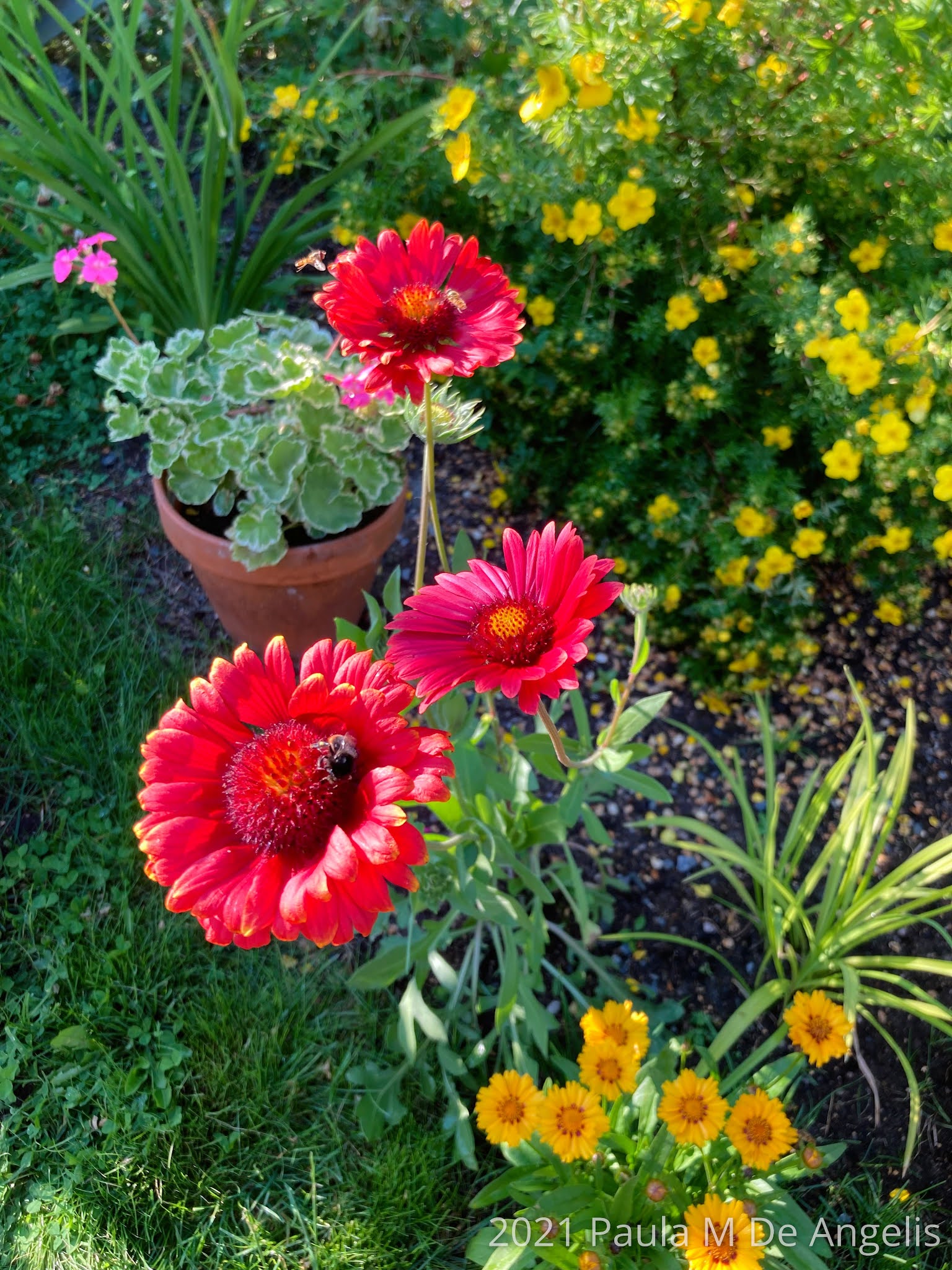 |
| burgundy Gaillardia aristata |
 |
| butternut squash developing |
 |
| sunflowers happily growing near the compost bin |
 |
| how the back side of the greenhouse looks now after all the plantings |
 |
| a view of the greenhouse front and back |
 |
| cherry tomato plants and potato plants in the foreground |
 |
| summer aster to the right and pumpkin plants in front of it in the foreground |
 |
| the birdbath area surrounded by flowers, a rose bush, a bamboo plant and rhododendron |
 |
| the main flower garden with rose mallows, lavender, peonies, Japanese maple tree, polemonium |
 |
| wild meadow flowers (I planted the seeds under the red currant bush where nothing usually grows) |
 |
| pachysandra spreading out under the krossved tree (nothing else will grow there due to the shade) |
Summer days in July
It is still summer in Oslo, in fact, it's been quite a warm summer from mid-June until now. My garden is thriving; we've already eaten zucchinis and cucumbers that grew quickly in the summer heat. We will have a bumper crop of tomatoes this year--both regular and cherry tomatoes. Whenever I am away from the garden for a few days, as I was now while we vacationed in Hedmark, and then come back to the garden, I am always in awe of just how much growth can occur in the space of a few days. Yesterday was the first day I was back in the garden after having been away since Monday. There were gooseberries and raspberries to pick, and the blueberries are also starting to ripen. I still have a formidable job of berry-picking ahead of me. The two gooseberry bushes alone are weighed down by the sheer numbers of berries on them. As I was picking raspberries, I was competing for each berry with the honeybees, who are now sucking the nectar out of the raspberries. They did that last year as well, but there were very few of them. This year it's as though all the worker bees descended on the raspberry patch.
Today is the last day of July, and next week it will be back to work for most of us. I will finish out the month of August and then I am free forever of the work world. But that is another story for another time. Today I want to share with you Mary Oliver's beautiful poem The Summer Day. The feelings and thoughts she describes in her poem are about where I am in life at present--willing to immerse myself in the nature around me, willing to abandon myself to the awe and wonder of it all. A garden is God's manifestation of a miracle in nature; how a pollinated flower produces a long hanging cucumber is a mystery and a miracle at the same time. I never cease to be amazed by the power and beauty of nature. I have said it before, but it's worth repeating--it is no surprise to me that paradise is described as the garden of Eden. Paradise for me would have to be a garden.
The Summer Day
Who made the world?
Who made the swan, and the black bear?
Who made the grasshopper?
This grasshopper, I mean--
the one who has flung herself out of the grass,
the one who is eating sugar out of my hand,
who is moving her jaws back and forth instead of up and down--
who is gazing around with her enormous and complicated eyes.
Now she lifts her pale forearms and thoroughly washes her face.
Now she snaps her wings open, and floats away.
I don't know exactly what a prayer is.
I do know how to pay attention, how to fall down
into the grass, how to kneel in the grass,
how to be idle and blessed, how to stroll through the fields,
which is what I have been doing all day.
Tell me, what else should I have done?
Doesn't everything die at last, and too soon?
Tell me, what is it you plan to do
With your one wild and precious life?
Subscribe to:
Posts (Atom)
Happy 250th Birthday, America!
I am hopeful again, after several years where I had begun to wonder if the USA would survive the onslaught of grifting and negativity in whi...
