- Life moves on and so should we. Spencer Johnson
- Accept yourself, love yourself, and keep moving forward. If you want to fly, you have to give up what weighs you down. Roy T. Bennett
- Let go of something old that no longer serves you to make room for something new. Roy T. Bennett
- One of the happiest moments in life is when you find the courage to let go of what you can’t change. Unknown
- God, grant me the serenity to accept the things I cannot change, courage to change the things I can, and wisdom to know the difference. Reinhold Niebuhr
- You can spend minutes, hours, days, weeks, or even months over-analyzing a situation; trying to put the pieces together, justifying what could’ve, would’ve happened… or you can just leave the pieces on the floor and move on. Tupac Shakur
- Inhale the future, exhale the past. Unknown
- Nothing in the universe can stop you from letting go and starting over. Guy Finley
- Close some doors. Not because of pride, incapacity or arrogance, but simply because they no longer lead somewhere. Unknown
- The only thing a person can ever really do is keep moving forward. Take that big leap forward without hesitation, without once looking back. Simply forget the past and forge toward the future. Alyson Noel
- When I let go of what I am, I become what I might be. When I let go of what I have, I receive what I need. Tao Te Ching
- You will evolve past certain people. Let yourself. Mandy Hale
- Let go of certainty. The opposite isn’t uncertainty. It’s openness, curiosity and a willingness to embrace paradox, rather than choose up sides. The ultimate challenge is to accept ourselves exactly as we are, but never stop trying to learn and grow. Tony Schwartz
- When one door closes, another opens; but we often look so long and so regretfully upon the closed door that we do not see the one which has opened for us. Alexander Graham Bell
- Creativity requires the courage to let go of certainties. Erich Fromm
- It is only through labor and painful effort, by grim energy and resolute courage, that we move on to better things. Theodore Roosevelt
- Courage is the power to let go of the familiar. Raymond Lindquist
- You don’t need strength to let go of something. What you really need is understanding. Guy Finley
Sunday, May 9, 2021
Quotes about moving forward and the courage to do so

Wednesday, April 28, 2021
Women and self-confidence
I could have entitled this post 'Women and self-confidence in academia'. But I reconsidered because many of my reflections can be generalized to other professions. It's just that academia is what I know. I've worked as a full-fledged scientist in academia for twenty-two years, and before that, spent six years working on my doctorate. I've worked in a mostly man-dominated profession--cancer research--even though during the last fifteen years or so women have made many inroads into this field. When I did my doctoral work during the 1990s, most mentors were men, and the one woman in my department who headed her own research group was unqualified for the position, in my opinion. Time proved me right.
I've had the privilege of mentoring/co-mentoring seven younger women and three younger men who have been interested in doing doctoral or Masters degree work. I've taken my mentoring responsibilities seriously, as I've done with most of my career responsibilities. All of the younger people I've mentored have finished their degrees successfully. Not one of them quit, although there were three women who wanted to quit at times (when life was made unbearable for them by other mentors). After many years in this business, I've realized that there are clear differences between women and men in terms of the self-confidence they bring to the table. Two of the men I've co-mentored took PhD degrees in record time; they were finished with their lab work within three years and defended their work not long after. Their self-confidence levels were high throughout; neither of them had any misgivings about their capabilities or expertise, and neither of them suffered from that nagging feeling that they were not good enough. They knew they were, and they acted accordingly. They didn't have to learn to take center stage; they were comfortable being the centers of attention when all eyes were on them. They adapted quickly, finished quickly, and moved into the private sector once they finished their doctoral work. The PhD degree was the key to their future career success in private industry; they understood that, and also made it clear to those around them that they were not interested in academic careers. These are my observations about them, after having had a number of conversations with them. We had a good rapport for the most part; the guidance they needed from me was more collaborative. They were driven and self-motivated, and if they suffered from any negative or anxious feelings, they hid them well. They also received a large amount of positive feedback and praise from their male co-mentor, who was a bit more sparse in dealing the same out to the women for whom he's been a co-mentor.
All of the women I've mentored/co-mentored had completely different experiences. They did not adapt to their chosen paths quickly. They took their time, felt their way forward, sometimes stumbling in the dark. They were not afraid to say that they were anxious about not measuring up, and in three cases, the treatment they received at the hands of the other co-mentor was often crippling to their self-confidence. When I have reflected upon this, I conclude that male mentors are more supportive of the men they mentor than they are of the women they mentor. I don't know why, but I wonder if it has to do with the level of comfort and camaraderie they feel with other men. I have had many discussions with this particular male mentor about his behavior; I've had to tell him not to be rude, disparaging, arrogant, and dismissive. He's been all those things, mostly to women. Perhaps he is an isolated case as a mentor. I don't know. He's had a lot of power and been given a lot of leeway. In short, he's been allowed to behave pretty much as he's wanted to all these years. He might not have behaved this way with the men he mentored because he knew they'd fight back. I don't know that either. The women have not fought back. Part of my mentoring them was to teach them to fight back--that they don't need to take all of the crap dished out to them (just because they are women). They are allowed to fight back; I've said that, and I've supported them when they did.
I've been available to my students, male and female. The men needed me less; the women needed me more. Almost thirty years after I started my own doctoral work, I see that times haven't changed all that much. I had no one to talk to when times got tough (my husband was some help, but he wasn't my main mentor), so I promised myself that when it was my turn to be a mentor, I would be there for my students. And I've lived up to that promise. My mentor was a man, by turns rude and supportive, if that is possible. He didn't push me around because he knew I'd fight him back, even though it took me some years to learn how to do that. He did respect my intelligence, albeit grudgingly at times. But as I've told the women I've mentored, I never had a problem with self-confidence when it came to my work. I knew I was good, good enough to be a scientist and good enough to be a project group leader. I know my limitations and my strengths. I've been told that I was good but not good enough by one of my research leaders (a man), and I ignored him and continued to do what I do best. I've gotten all my students through their degree work; he has not. He has harassed many of the post-docs he's hired and they left his lab demotivated and discouraged about their place in science. I know this because they (women and men alike) have come into my office to share their stories with me over the years. He made mincemeat of whatever self-confidence they had at the time they were in his lab. Why? Who knows. I could write a long treatise on him, but he's not worth the effort. One thing is clear to me; the harassment of women doesn't end when they finish their doctoral work. Once a woman becomes a worthy competitor to a man, that's when the harassment intensifies. Academia is a hotbed of competition, bad behavior, arrogance, and harassment. Sometimes it amazes me that any good work actually gets done amidst the political crap that goes on. I wonder too how some people live with themselves.
Being a mentor involves so many things, but mostly it boils down to coaching and motivation, in addition to understanding the work involved. You cannot be a good mentor unless you understand the projects, the science, the lab work, and the ins and outs of academia. I am a cheerleader of sorts, praising students for a job well-done, listening to them when times are tough and providing encouragement to continue working when everything seems dark and unforgiving. There is always a light at the end of the tunnel. Keep placing one foot in front of the other and you'll get there. The only way out is through. Don't give up. This too shall pass. Sometimes just saying those words is enough for some students. Knowing that they've been listened to, that someone cares about them and their projects and goals, is the motivation they need to continue. If I've played such a role in their lives, I've done a good job, and I'm happy. And it makes me happy to see them succeed.
Monday, April 26, 2021
A time for change
There is a time for everything under the heavens, as Ecclesiastes 3:1 says. The entire verse is as follows:
- There is a time for everything, and a season for every activity under the heavens
- a time to be born and a time to die,
- a time to plant and a time to uproot,
- a time to kill and a time to heal,
- a time to tear down and a time to build,
- a time to weep and a time to laugh,
- a time to mourn and a time to dance,
- a time to scatter stones and a time to gather them,
- a time to embrace and a time to refrain from embracing,
- a time to search and a time to give up,
- a time to keep and a time to throw away,
- a time to tear and a time to mend,
- a time to be silent and a time to speak,
- a time to love and a time to hate,
- a time for war and a time for peace.
I would add--there is a time for stability, and a time for change. This is essentially covered by 'a time to plant and a time to uproot' if you don't interpret the words literally. Flowers that are planted root in the soil in order to grow well, and it isn't until they are uprooted for whatever reason that the idea of change comes into the picture. We talk about uprooting families and children from what is 'known' and moving them to what is 'unknown'. We talk about doing the same with ourselves. Sometimes life's misfortunes and circumstances do it for us--uproot us and move us out of our comfort zones. We may not always like being moved out of our comfort zones for whatever reason. We may not like the feelings of anxiety, confusion, irritation, and misgivings that accompany change, but change is a part of life. It's a part of life that can make us fearful, so perhaps the best thing we can do for ourselves is to try to prepare for change. Not constant change, but rather major life changes. I remember having that conversation with my mother many years ago when I was a young adult; it was my contention that it was possible to prepare for some life changes, e.g. children leaving home and the empty nest syndrome. I think it's best to prepare in order to not be blindsided by change or by the people who enact and enforce that change. It is always best to choose for oneself; how changes are going to go down and how they might impact on us; that way, the amount of change doesn't have to be overwhelming.
There are changes in store for me and others I know. Some of them are pleasant and some are not. Some of them are anxiety-inducing. All of them are life changes. One must be able to visualize oneself going through the changes and emerging on the other side of change. I have done that, and I can see myself on the other side now.
Thursday, April 22, 2021
My poetry collections
I've been writing poetry for many years, since I was fourteen years old. During the past ten years or so, I've been able to publish most of what I've written over the years as different poetry collections, which I've listed here:
- Cemetery Road, published in 2019
- Quantum Bloom, published in 2015
- One Hundred Haikus for Modern Workplaces, published in 2014
- Remnants of the Spirit World, published in 2014
- Parables and Voices, published in 2011
All of them are available for purchase on Amazon.com
My Amazon Author page provides the links to each book: Amazon.com: Paula M. De Angelis: Books, Biography, Blog, Audiobooks, Kindle
Wednesday, April 21, 2021
Street life-Randy Crawford
One more favorite from the Jackie Brown soundtrack......Street Life is the title track from The Crusaders album from 1979 featuring singer Randy Crawford. Love it!
Brothers Johnson - Stomp! (Official Video) (1980)
Not from the film Jackie Brown, but another song by the Brothers Johnson that I love and remembering dancing to.....
Brothers Johnson - Strawberry Letter #23 (1977)
One of the great songs from the soundtrack to the film Jackie Brown......I'm including the lyrics:
Hello my love, I heard a kiss from you
Red magic satin playing near, too
All through the morning rain I gaze, the sun doesn't shine
Rainbows and waterfalls run through my mind
In the garden, I see
West purple shower bells and tea
Orange birds and river cousins
Dressed in green
Pretty music, I hear
So happy and loud
Blue flowers echo
From a cherry cloud
Feel sunshine sparkle pink and blue
Playgrounds will laugh
If you try to ask
"Is it cool?"
If you arrive and don't see me
I'm going to be with my baby
I am free, flying in her arms
Over the sea
Stained window, yellow candy screen
See speakers of kite
With velvet roses diggin'
Freedom flight
A present from you
Strawberry letter 22
The music plays
I sit in for a few
Ooh, ooh, ooh, ooh, ooh
Ooh, ooh, ooh, ooh, ooh
Ooh, ooh, ooh, ooh, ooh
Ooh, ooh, ooh, ooh, ooh
A present from you
Strawberry letter 22
The music plays
I sit in for a few
Ooh, ooh, ooh, ooh, ooh
Ooh, ooh, ooh, ooh, ooh
Ooh, ooh, ooh, ooh, ooh
Ooh, ooh, ooh, ooh, ooh
Ooh, ooh, ooh, ooh, ooh
Ooh, ooh, ooh, ooh, ooh
Ooh, ooh, ooh, ooh, ooh
Ooh, ooh, ooh, ooh, ooh
Source: LyricFind
Songwriters: Shuggie Otis
Strawberry Letter 23 lyrics © Universal Music Publishing Group, BMG Rights Management, Warner Chappell Music, Inc
Tuesday, April 20, 2021
One of my favorite films and soundtracks--Jackie Brown
I watched the film Jackie Brown again last night. I don't know how many times I've seen it, but it's one of those films worth seeing again, just to appreciate the acting (all of the actors and actresses are superb in their roles) and to fill in the small plot gaps that one may have missed the previous times. It also has a great soundtrack; I love listening to the songs--many are from my growing-up and young adult years. If you want to just get away for a few hours and enjoy watching (and listening) to a film, I recommend Jackie Brown. It came out in 1997, but I don't remember seeing it for the first time then. I think I may have avoided it because Quentin Tarantino was the director, and his films are so eclectic and violent that I was unsure how this film would be. It is violent, but not any more so than many other films in this genre. I've seen worse violence, to put it that way.
Pam Grier is stewardess Jackie Brown--cool, composed, smart and calculating. I can't see anyone else playing this role; she is just so good in it. Jackie Brown is no fool, and has no qualms about setting up illegal weapons dealer Ordell Robbie (played by Samuel L. Jackson) in order to get him out of the way and to keep his money while playing the FBI as well. After all, Ordell doesn't care whether she goes to prison for smuggling his money into the USA from Mexico, it's about survival of the fittest. Ordell is also smart, but not as smart as Jackie. Robert Forster is also so good as Max Cherry, the bail bondsman who falls in love with Jackie Brown at first sight and decides to help her. His basic decency prevents him from taking any of the money she will possibly end up stealing, except for the regular fee he charges all those who request his services.
Quentin Tarantino apparently revived the careers of both Pam Grier and Robert Forster by choosing them to be in this film. He had good instincts in choosing them, because they are excellent actors and perfect for their roles. Samuel L. Jackson is also quite good, Robert De Niro, Michael Keaton, and Bridget Fonda likewise. A very good movie ensemble.
As I mentioned, the soundtrack is also a big part of the movie, with the following songs:
- "Across 110th Street" by Bobby Womack and Peace
- "Strawberry Letter 23" by The Brothers Johnson
- "Who Is He (And What Is He to You)?" by Bill Withers
- "Tennessee Stud" by Johnny Cash
- "Natural High" by Bloodstone
- "Long Time Woman" by Pam Grier
- "(Holy Matrimony) Letter to the Firm" by Foxy Brown
- "Street Life" performed by Randy Crawford
- "Didn't I (Blow Your Mind This Time)" by The Delfonics
- "Midnight Confessions" by The Grass Roots
- "Inside My Love" by Minnie Riperton
- "The Lions and the Cucumber" by The Vampire Sound Incorporation
- "Monte Carlo Nights" by Elliot Easton's Tiki Gods
My favorites are Across 110th Street, Strawberry Letter 23, Street Life, and Inside My Love. After I watched the film, I downloaded the soundtrack to the movie from iTunes. And that got me started on 1970s soul songs; I went searching for some of my favorites, and downloaded them too. Isaac Haye's Theme from Shaft, Betcha by Golly Wow by The Stylistics, Whatcha See is Whatcha Get by The Dramatics, Rock Your Baby by George McCrae, and Back Stabbers by The O'Jays. Listening to these songs is a total trip down memory lane, and a very pleasant one.
Sunday, April 11, 2021
An ethics lesson in the midst of a pandemic
Here is a hypothetical situation concerning getting the vaccine against the coronavirus. A hospital department contacts its employees late on a Saturday evening to let them know that if they want, they can get the vaccine that evening. The only thing the department employees are told is that the vaccine expiration date is the following day--Sunday, so the vaccines must be used up quickly. Around two hundred employees show up to take the vaccine; all are wearing masks, and all are trying to practice social distancing while waiting in line. One of the organizers walks around counting heads and telling the employees in a loud voice to remember to stand six feet apart. It is only when each employee is sitting with the vaccinator that he or she is told that the vaccines had not been stored at the right temperature and that there is a question as to whether or not they will be effective at producing antibodies against the virus. In other words, showing up for the vaccine dose may mean that the trip was a wasted effort. The vaccine may work, which would be good news, and it may not work, which is not good news. The latter means waiting for a new first vaccine dose; for some employees, this is a rather bitter pill to swallow because some of them lose their place in the regular vaccine line sponsored by the city municipality where they live or the hospital where they work. The hospital department that arranged the vaccinations has apparently not contacted upper hospital management about their vaccination program arranged on the fly; in other words, the left hand doesn't know what the right hand is doing. The hospital department decides to arrange for antibody testing starting around seventeen days after the vaccination date; it will call in each employee for a blood test and test for the production of antibodies against the virus. This could take some time--both the blood collections and the antibody tests--so it is uncertain when the results of the tests will be available. In the meantime, older employees (circa sixty-five to seventy-five years old) are being called in by the city municipality to get vaccinated. The municipality has no idea that these employees have been vaccinated with a possible ineffective vaccine dose. The employees are stressed because they are unsure of what to do--wait for the department to arrange everything, or take the new vaccine dose offered them. If they don't take the latter offer, they may lose their place in line and may have to wait another month or more to get a functioning vaccine. During a pandemic, the stress factor is high and nerves are frayed. It would be best to give employees the whole story, right from the start.
If you were one of these employees and were a student in an ethics class, you might broach the following questions for discussion:
- Why weren't the employees told the whole story--that the vaccines might be ineffective?
- Why were only some few leaders told the whole story, and why didn't they inform all employees?
- Why wasn't there a general announcement that evening before vaccinations started that the vaccines might be ineffective?
- Are the results of these vaccinations going to be used in a research article of some sort? If so, all employees must consent to the use of their data in an eventual article. Some may choose not to.
- Even if the information gained from such a project is useful and informative, which it actually is, it would have been better to have fully informed employees about what they were signing up for.
- Does this type of behavior help to build employee trust in management?
This is as it turns out, a true story. While all the employees will eventually get vaccinated with a second dose if the vaccine they received proves effective, and there is good reason to believe that it is effective, it would have been far better to have fully informed all employees. Some leaders will say 'what's the big deal? It all worked out well. Why are employees dissatisfied?' The answer is that they're happy to have been vaccinated, but dissatisfied with the way it went down. It's a learning experience for all leaders. The next time, they should make sure that all employees are fully-informed. That way, it's win-win for everyone.
Saturday, April 3, 2021
Happy Easter
A lovely Easter scene at my friend Jean's house--some beautiful spring flowers in front of a statue of Saint Francis of Assisi (my favorite saint). I love the statue and the color combination of the flowers--just seeing them makes me happy. I asked her if I could share her photo and she said yes. I'm also including the text to the prayer of Saint Francis of Assisi--one of my favorite prayers. We need more instruments of peace in the world, more people willing to bring joy, hope, light and truth into the lives of others. Happy Easter to everyone! 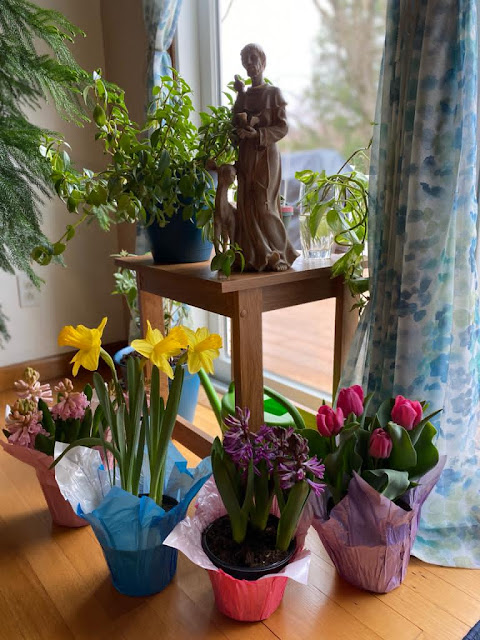

Prayer of Saint Francis
Lord, make me an instrument of your peace.
Where there is hatred, let me bring love.
Where there is offence, let me bring pardon.
Where there is discord, let me bring union.
Where there is error, let me bring truth.
Where there is doubt, let me bring faith.
Where there is despair, let me bring hope.
Where there is darkness, let me bring your light.
Where there is sadness, let me bring joy.
O Master, let me not seek as much
to be consoled as to console,
to be understood as to understand,
to be loved as to love,
for it is in giving that one receives,
it is in self-forgetting that one finds,
it is in pardoning that one is pardoned,
it is in dying that one is raised to eternal life.
Friday, April 2, 2021


The gift of a poem at Easter
I love this poem for so many reasons that you'll understand when you read it. Enjoy. Wishing all my readers a very Happy Easter!

Wednesday, March 31, 2021
Reflections on the last day of March
The last day of March. The days roll by, the months likewise. One year ago, pandemic lockdown started. One year later, we're still not out of the woods. It's strange to think about. Surreal, really. I've given up trying to follow the news in any great depth. I manage to grasp the gist of news stories without really perusing them. I gravitate toward more optimistic articles, but even those tire me out after a while. I am not sure what I'm waiting for. I want society to get vaccinated and to reopen, but I have a feeling the whole thing will be anti-climactic by the time that happens. My trust in science has not really wavered, but my trust in leaders and politicians has not gotten stronger during the past year. In all fairness, I understand that they are just human beings like the rest of us, woefully unprepared for what has happened and scrambling to make the best of a bad situation.
The only place I feel whole these days is in my garden. The rest of the time I feel rather fragmented, pulled in all directions, by what is going on in the world, by country and local politics, by workplace politics and leadership (or lack thereof), and by spiritual leaders. It's all too much and it's all too overwhelming. The garden keeps life simple. It needs what it needs and you know what you need to do, each year, every year for as long as you have a garden. The garden keeps me sane. There's a job to do, a goal that gives one purpose. Our divorce from the natural world has come at a high price, too high if you ask me. But no one is asking me. I look at the urban policies just in Oslo alone. They keep on building and building ugly modern minimalistic new apartment buildings; all of them look the same and all of them have the same purpose, to pack as many people into them as possible. Oslo is to become an urban city--large, sprawling, packed with people. Why, I'm not sure. It's part of the Green Party politics, but I don't think their politics are smart. When one looks at pandemics, for example, it's clear that living together like sardines is not a good idea for keeping a pandemic infection rate low. Oslo can never become Manhattan, and why should it? Manhattan is Manhattan, and much of what characterizes Manhattan is due to politics from one hundred and two hundred years ago; having people packed into tight living quarters was not so much a decision as a result of and a need for dealing with the number of immigrants to the USA around the turn of the 19th century (late 1800s to early 1900s).
My husband and I got the first dose of the Pfizer mRNA vaccine this past Saturday. Without going into a lot of detail, there are questions as to whether the actual vaccine we received, which was not stored at the correct temperature and needed to be used up, will actually work; will our immune systems produce antibodies against covid-19? We were only told that its expiration date was on Sunday and we decided to take it, as did many other hospital employees that evening. At the same time, the Oslo municipality is calling in its residents to get vaccinated, and this is again separate from our hospital's vaccination plan, which is again separate from the vaccination program on Saturday. We got a message from the municipality yesterday saying that we will be called in soon to be vaccinated. The problem of course is that we don't know yet if the first dose we got on Saturday will work (it takes twelve to fourteen days to produce antibodies) so that we are hoping against hope that we get called in to be vaccinated at the three- to six-week time point, so that we can either get a second dose (or a first new dose), depending on whether the original first dose is effective or not. Complicated? Yes. It always amazes me how a small country can make things so complicated. The major problem is the lack of complete information; we get dribs and drabs of information but never the entire story. It's akin to being treated like stupid sheep, which I hate. It will probably all work out, but the ensuing disorder and logistical disturbance are totally boring and unnecessary.
Liquor stores remain open, likewise pharmacies and supermarkets. They do a good job of controlling the numbers of people allowed in at any given time, so no complaints. Otherwise, most everything happens online; you order online and your order is either delivered to your home or you go to the store to pick it up. Those stores that don't provide online ordering have suffered and some will probably close for good eventually (unfortunately). Pubs, restaurants, and training centers remain closed indefinitely. Not sure about massage parlors or tanning salons. Hair salons remain open. Churches remain closed.
I read the news from the USA, and it's not very encouraging there either. Spring break in Florida, where social distancing is non-existent. Rape and murder of a young woman who traveled on her own to Florida for spring break. Hate crimes against minorities. The level of racism in the USA appalls me; I wish the racists would go back to hiding under their slimy disgusting rocks. Politicians together with underage young women. NY State governor Cuomo accused of sexually harassing a number of women who worked for him. Republican men who won't get vaccinated. Still a huge amount of support for Trump. It's tiring to read and to listen to. When does it all get better? A vaccine against covid-19 won't impart immunity against stupidity, idiocy, hatred, racism, vitriol and bad behavior. I wish it did, but even if it did, there'd still be many people who wouldn't take it. Guaranteed. Because there are some people who won't listen to any reason and who only have contempt for science. It's always been that way, and at one point in time, even churches erred on the side of ignorance when it came to supporting or not supporting scientists. Luckily that is no longer the case for the most part.
We are three days away from Easter Sunday. I am hoping for a resurrection into a new year filled with life, not death, filled with good things, not bad. I am hoping for an Easter miracle, a rebirth of values, ethics, good behavior, kindness and empathy--for us all.
Saturday, March 27, 2021
Pink Floyd - Us and Them, from the album Dark Side of the Moon
Dark Side of the Moon by Pink Floyd is probably my favorite album of all time. An amazing piece of work from start to finish, every song a masterpiece. The first time I heard it, it blew me away, and still does, all these years later.
This song, Us and Them, is every bit as relevant now as it was back in 1973. I'm not sure what happened to music over the years, but there is very little music made today that even approaches the creativity found in this album. This music touches your soul; the lyrics are poetry.
Us And Them
Us and them
And after all we're only ordinary men
Me and you
God only knows it's not what we would choose to do
"Forward!" he cried
From the rear
And the front rank died
And the general sat
And the lines on the map
Moved from side to side
Black and blue
And who knows which is which and who is who?
Up and down
And in the end it's only round and round and round
"Haven't you heard
It's a battle of words?"
The poster bearer cried.
"Listen, son,"
Said the man with the gun,
"There's room for you inside."
"Well, I mean, they're gonna kill ya, so like, if you give 'em a quick sh...short, sharp shock, they don't do it again.
Dig it? I mean he got off light, 'cause I could've given him a thrashin' but I only hit him once.
It's only the difference between right and wrong, innit? I mean good manners don't cost nothing, do they? Eh?"
Down and out
It can't be helped but there's a lot of it about
With, without
And who'll deny it's what the fighting's all about?
Out of the way
It's a busy day
I've got things on my mind
For want of the price
Of tea and a slice
The old man died
Friday, March 26, 2021
Leadership and followship
I've been thinking about leadership, about leaders who inspire and have inspired me, and it occurred to me that I have been willing to follow such leaders during my long work career. I have not been willing to follow leaders who do not inspire me. For me there is a clear-cut line between real leaders and fake leaders, and what separates them is their ability to motivate others, to inspire others with their ideas and thoughts. Fake leaders are those who are leaders in name only; they are only interested in the title, prestige, and money attached to the position. They have no idea of how to lead others or how to motivate them. Unfortunately, there are too many of the fake leaders and not enough of the real leaders.
I've been thinking about this since I found out that all three of my managers at Memorial Sloan-Kettering Cancer Center have passed, the first in 2013 and the other two during the past six months. They were my managers, but they were real leaders, all three of them. One was an innovative pathologist who led the pathology department, the second was an idea-rich medical doctor/researcher, and the third was an attention-to-detail basic researcher who pulled it all together. They were an excellent team that managed to present their ideas to their team of employees, who worked hard to translate those ideas into reality. The results were good publications, successful grant applications, money to hire people and to buy consumables for the lab, travel to conferences to present our data, and money to buy state-of-the-art flow cytometers that our lab used at that time.
There really is nothing new under the sun. I've googled the terms 'leadership and followship' and discovered that I'm not the first one to coin the term 'followship'. As I've pointed out above, followship is a good thing if those one follows are real leaders who inspire their employees. Followship is not a good thing if it is characterized by passivity, conformity, lack of good ideas, lack of motivation, and a pervading sense of mediocrity. Negative followship implies that the leaders employees follow are not real leaders. Unfortunately, there is too much negative followship afoot, also in society at large. Rather than think for themselves, many people prefer to simply accept what they read online or in the media generally, without weighing the consequences or debating the wisdom and truth in what they read or watch on television. They would rather be passive and conformist, and those traits can be manipulated and abused by unethical leaders.
When I had the chance to lead a small project research group over ten years ago, I managed to do a good job, according to the feedback I've gotten from those who worked for me and with me. One young woman even said to me that she hoped she would be like me when it was her chance to lead others. Others have said that they have learned a lot from my leadership style. I've been told that I am a good people manager, but I know too that many of my scientific ideas were good and that the research projects that we were involved in were interesting and timely. Ground-breaking, no. But relevant, yes--work that may have advanced some of the knowledge in the field. I can live with that, now that my career is nearing its natural end. I would rather know that when it was my turn to lead, I stepped up to the plate and did a good job of leading and inspiring others. That's all that matters to me at this point.
Snowdrops and honeybees
Spring is here and daytime temperatures are getting warmer. I did several days' work in the garden during the past two weeks. I usually make myself lunch and a thermos of tea, and start my garden day by eating lunch in the garden. Then I get to work, raking, cutting dead flowers, clipping the raspberry and blackberry bushes, and spreading compost soil on the vegetable beds in order to prep them for the coming garden season. I've also sowed out different seeds in the greenhouse--pumpkin, butternut squash, tomatoes, rose mallows, sunflowers, and hollyhocks. There is still a lot of prep work to do, but it's work that relaxes me in this pandemic time. Who knew that we would be starting a second year of this scourge? At least when I'm in the garden, I don't think about the pandemic at all.

It's still too early for most flowers to bloom, but the bulbs are beginning to poke their heads up out of the soil--crocuses, daffodils, tulips, and hyacinths. The only flowers that have bloomed so far are the snowdrops. They're spread around the garden (by design) and each year the patches grow a bit larger. This past Monday, the largest patch had visitors--honeybees and a butterfly. I didn't know that they liked snowdrops, but they do, and now I know that. Nature always has something new to show us, to teach us. Here's a photo I took the other day, showing a couple of bees if you look closely.

Saturday, March 20, 2021
More pandemic humor
Pearls Before Swine is probably my favorite comic strip at this point in time. Stephan Pastis has had so many good commentaries on the pandemic in which we find ourselves trapped. Here are some recent strips that are pretty funny.


Friday, March 19, 2021
Pandemic humor
My friend Stef has been sending me coronavirus-inspired cartoons and memes since shortly after the pandemic started. These two made me laugh out loud......


Wednesday, March 17, 2021
Exit and the quest for more and more money
It strikes me, after having seen seasons 1 and 2 of Exit,
the Norwegian series about four investment brokers--Henrik, Jeppe, William, and
Adam--in the Norwegian financial world and their (mostly miserable) personal
lives, that we have been handed a morality tale, yet again, on the evils of
greed. Much like Wall Street and The Wolf of Wall
Street, where ‘greed is good’, except that it isn’t. We the viewers know
it, the creators and producers of the series know it, and the actors know it.
There’s a price to pay for being greedy, and it’s huge, even though payment
might not come due immediately. But because Exit is a series
and not a movie, it’s possible to delve into the lives of each of these men,
and you come to learn quite a lot about them and what made them the way they
are. None of them are nice men, none of them are men you root for, and none of
them are men you’d like your daughters to marry. They are actually evil men,
except that their brand of evil is banal—they are unfaithful husbands, whore
chasers, alcoholics, and drug users—by choice. Some of them are bullying and
aggressive (violent) toward other men (Jeppe and Henrik) while one of them
(Adam) is a bona fide wife abuser. There are several scenes with William, where
the camera focuses on his face and his eyes, which hold a contempt for others
that is positively chilling. Overall, these men are dinosaurs when it comes to
their views on women and careers. Their dinosaur stance is that they are the
providers, they want to marry trophy wives who don’t work and who bear them
children who are mostly raised by au pairs, and they end up resenting their
trophy wives for loving the life and the money that they provide for them. Part
of the deal between marital partners is that the trophy wives don't complain
when their husbands work long hours, are out late, don't account for their
absences, and have little or nothing to do with raising the children.
Exit is not for everyone, definitely not for the prudish, because of the amount of sex and no-holds barred presentation of prostitution and sexual activity. It’s all staged, that I know. But nevertheless, it pushes the boundaries for what could be considered decent behavior in most circles. Perhaps there is a point to it, or perhaps not. Perhaps the series’ creators and producers are cynical enough to know that sex sells. It does, because Exit has been a ratings hit here in Norway (both seasons 1 and 2). When the series is sold to other countries, it will probably do well there also. The acting is very good, the storylines likewise. It’s a soap opera for adults with lots of sex, about the financial world, the highs, the lows, the drug abuse, the alcohol abuse, the cynicism, the hubris (that comes before a fall), and the daily abuse by these four men of people who would be seen as normal people under most circumstances. These four men have zero concept of what happiness is; the strange thing is that they know it, and still they carry on doing all the things that most of us would never do. They are on a quest for more and more money and greater and greater kicks, and that can only lead to one end—the deaths of others or the deaths of themselves, or both. At heart, they are miserable human beings who ruin the lives of most people with whom they come into contact.
The character William tried to commit suicide in season 1
after many bouts with cocaine abuse and alcoholism. He enters rehab, only to
return to the same environment that he left—an empty soulless environment that
really does not permit or encourage sobriety, monogamy, fidelity, kindness, or
empathy. So he falls again and again, and by the time season 2 ends, it’s not
clear whether he will survive. The story does not really create much compassion
for him; rather, it seemed that the inevitable outcome of the storyline will be
his death, and it seemed almost natural that it should end up that way. That
actually seemed fine with me since he doesn’t really want to continue living
and since no one can get through to him. He wants to die. The others lead
pointless lives with wives and children for whom they have little or no
feelings or connection. They would rather party, screw hookers, and dull their
consciences with booze and cocaine. They would do that 24/7, except that they
cannot because they always have to wake up, sober, and start a new workday,
until they can dull their consciences again later on in the day.
One of the best scenes in season 2 is when Jeppe manages to
get his divorced elderly parents together in the same restaurant. His mother
and father (who now has a terminal illness) divorced due to his father’s
predilection for whores, his infidelity, and his mistreatment of his wife. When
you see the father who once was like Jeppe, but who is now lonely and decrepit,
you see Jeppe as an old man, and he is aware of that on some level. His mother
has no use for his father, and only agreed to the restaurant meeting to please
Jeppe. When they all sit down at the table and begin to look at the menu, his
mother suggests to his father that perhaps he should order some ‘ung due’
(young pigeon) or ‘små rype’ (small birds). The insinuation is clear, and it is
an excellent scene showing his mother’s visceral hatred of her ex-husband.
Jeppe’s father gets the not-so-subtle message, some unkind words are exchanged,
and he leaves the restaurant. There is no reconciliation as Jeppe had hoped for
before his father dies. Again on some level, it registers inside of him that
this could well be his future as an old man.
So what is the point of their lives, of living in this way?
These men have it all—great material success and a lot of money--and yet they
have nothing. They are morally bankrupt. It’s been said many times before--the
quest for more and more money is nothing but greed. I look at the television
portrayal of these men and their ‘successful’ lives--beautiful large houses,
expensive sports cars, extensive wine cellars, built-in pools, yachts, private
planes, being able to afford expensive restaurants and to travel, and I think
to myself—so what? Absolutely none of it appeals to me—not the materialism, not
the unbridled ambition and aggression, not the greed, not the cynicism attached
to the greed, not the cynicism attached to the abuse and exploitation of women,
not the ennui. It’s a bore, all of it. To paraphrase the bible—what does it
profit a man if he gains the whole world but loses his soul? Indeed. Is it
worth it? What is the meaning of life between birth and death? What should one
do with all those years in-between, if one is so lucky to have been given a
long life? Should one waste it on activities that produce nothing, like working
as an investment broker, partying, contributing nothing of value to society and
the lives around you? It seems to me that a life spent on intellectual, vocational, and/or creative pursuits is a much better life, not necessarily always happier, but much
better spent, with something concrete to be proud of at life’s end.
There are also people who don’t work as investment professionals for
whom money is paramount. They live their lives in an endless quest for more
money, and the more money they go after, the more they fail at one scheme or
another that is going to make them rich. They want money too much. They make stupid and irrational mistakes trying to attain
it. They don’t use their heads. They trust the wrong people. They exploit their
families and friends. They are rude to other people, behave like narcissists,
and think that the world owes them a living. They are ‘high maintenance’
individuals, often live (or have lived) lives of privilege, generally lack
gratitude for most of the good things in their lives, and have no idea of what
it means to be happy. Some grew up without money, some grew up with plenty of
it; thus there is no meaning to be derived from their upbringings. Some of them
have fallen on hard times. I observe such people from a distance. Like the
scientist I am, I study them and have for years. If they ever do become rich,
it will have less to do with brains and intellect and more to do with pure
luck, just statistics. Perhaps it was ‘just their time’. Or perhaps not. It is
strange, this thing called greed. It makes people behave in strange ways, it
makes them rude to others, it makes them proud, it makes them abusive, and it
makes them miserable people to be around. There are wealthy people who have
learned to live with their wealth, who live their lives wisely, who do not
abuse others, who have humility, and who do not feel the need to flaunt their
material possessions. So it is possible to behave decently and have a lot of
wealth. It's just that we rarely hear about such people.
Thursday, March 11, 2021
Social media and unhappiness
I still use Facebook, but less and less these days. Since I live abroad, it remains a good way to stay in touch with my friends and colleagues in the USA. But after the political circus that was the 2020 election and Facebook's huge (and unforgivable) failure to block fake news, I lost a lot of respect for them and for social media generally.
There is research that shows that social media makes people feel unhappy, but much of it that unhappiness has to do with your popularity on whatever medium you use most, according to this article: Social media makes people feel unhappy, less popular: Study | Business Standard News (business-standard.com). Perhaps the bigger problems in terms of creating unhappiness are how much time one wastes on social media when one could be using that time more productively, and how unhappy one can become if one sees that friends or colleagues seem to be having a better life than you have. One can be assuaged by the fact that most people using social media are probably in the same boat--happy at times, frustrated at others. No one's life is perfect, no matter how perfect it may seem on social media. So my guess is that the more time you waste on Facebook, the more your brain will believe that others are happier and better off than you are. Just remember that this is not true; in fact, it's nonsense. There is no perfect world.
I'm generally not hugely affected one way or another by what people post--if it's happy news I'm happy for the poster, if it's sad news, I'm sad for them. I usually remain on an even keel. Recently I found out, via Facebook, that one of my three bosses from my workplace at Memorial Sloan-Kettering Cancer Center passed away; he was 84. His son posted a nice tribute to him on Facebook; that is one of the good things about Facebook, being able to find out such things and being able to leave a tribute of one's own. It makes paying your respects and sending condolences much easier, as I found out when my brother died in 2015. It was nice to hear from the people we grew up with, fellow Tarrytowners.
But still, I found this Pearls Before Swine comic strip from yesterday, quite funny, and probably true for a good many people. Stephan Pastis seems to be focusing on the perils of social media these days, and he's come up with quite a lot of humorous strips.

Sunday, March 7, 2021
Just one more
Today's Non Sequitur by Wiley comic strip (another one of my favorites) was pretty apt as well 😀:

'If real life was like social media'--Pearls Before Swine for today
I love the comic strip Pearls Before Swine; I've been following it for years. It has the type of irony and zaniness that appeal to my sense of humor. This was today's strip--pretty apt:

Saturday, March 6, 2021
Elena Ferrante's The Lying Life of Adults
I begin Elena Ferrante's novels with a mixture of
fascination and dread. Fascination, because everything I've read by her has
gripped me. Her novels are riveting and her words flow on the pages, moving me
along and immersing me in her Italy, her Naples, and her family dramas that she
has carefully constructed. Dread, because I know that this immersion will stir
up the mud in my own life and memory; it will murky the waters that I think are
so clear, and yet when I dive deeper, I know they aren't.
How is it that one person, one writer, can speak to me and
to so many people at the same time? She has an uncanny way of getting right to
the core of what drives families apart and what keeps them together. She
describes the behaviors, utterances and dramas that comprise the push and pull
of family life, mostly without judging them, and that is where the fear comes
in. Because you know that the behaviors she writes about are real and often violent
to the spirit and body. Sometimes she judges them, but only within the contexts
of her characters, the ones who want to escape the oppression, claustrophobia,
and violence of family life. She allows them to judge, and we follow their
attempts to escape, which are seemingly successful, but we know that somewhere
down the line, the past will knock on their door and demand its due. At some
point, they will face the same situations that they ran from, and come face to
face with their early selves—the ones who said that they would never tolerate
this or that behavior, the ones who said that they would never behave like
their parents, aunts, uncles and grandparents. They experience the human
frailties, deceptions, betrayals, frustrations, rage, and even violence
(psychological and physical) that can be part of family life. The characters in
her books are flawed human beings, like we all are. Perhaps that is part of her
appeal. She explains some parts of our lives for us; I know she does that for
me. I finish her novels thinking, yes, that helps to explain this or that
family member’s behavior, or utterances, or bizarre points of view.
Everyone lies in Ferrante’s novels. Adults lie, but so do
children and teenagers. The Lying Life of
Adults is really the story of how teenagers become adults who lie to
themselves and to others. It is the story of how we become the adults we
profess to hate. Giovanna, the main character who is a teenager, is acutely aware
of the hypocritical behavior of the adults in her life. She has two friends she
confides in, Angela and Ida, the daughters of her parents’ friends Mariano and
Costanza. Her attempt to develop a relationship with her hated aunt Vittoria,
her father’s sister, has far-reaching repercussions for her parents, her
parents’ friends, involved children, and her own life. Vittoria is a destructive
force of nature. She is (presumably) the opposite of Giovanna’s educated, intellectual
and refined father, Andrea, who hates his coarse uneducated sister (the feeling
is mutual), and yet, that is what Ferrante wants to show us, that at their
core, both Vittoria and Andrea are the same. They are egotists and liars, they
think nothing of destroying others’ lives by wanting what they want (Vittoria
wanted Enzo--the husband of her friend Margherita, and Andrea wanted Costanza—the
wife of his friend Mariano). They justify their betrayals of spouses and
families and lie to themselves about how ‘noble’ their intentions are. Nella,
Andrea’s wife, is crushed by his betrayal and their eventual divorce, but tries
to live her life following the divorce as best she can. Mariano, who has
cheated on Costanza often, is also lost; eventually Nella and Mariano find each
other despite Nella’s protests to the contrary. Giovanna is witness to all of these
happenings. At the same time, she becomes friends with Vittoria (who worshipped
Enzo), Margherita, and Margherita’s children (Corrado, Tonino, and
Giuliana). Vittoria dominates Margherita and her children’s lives; she tells
them how to live and what to do and not to do. The relationship between
Vittoria and Margherita is strange and one I found hard to understand, but for
the purposes of the book, I accepted it. But I know very few people in real
life who would have become friends with their husbands’ mistresses.
Vittoria brought to the surface memories of my father’s eldest
sister Carmela, who was also not much-liked in my family. Unlike Vittoria, she
was considered to be good-looking; she was a refined woman with many intellectual
and cultural interests. But she was a drama queen, and no family gathering ever
ended pleasantly when she was present. She was unhappily married to one of my
father’s childhood friends, which didn’t help matters. My father probably felt
pressured to take sides, and he took his sister’s side against his friend. My
mother and my aunt did not get along at all; my mother found her domineering,
controlling, and nosy. Carmela and her husband eventually divorced; she lived
alone afterward until she died, but did have a lover whom she could have married
but chose not to. After one too many unpleasant family gatherings when we were
children, my father and mother decided not to see her anymore, and by
extension, we were not to see her either. After my father died, my sister and I
made an effort to re-establish contact with her. We found her to be a decent
person, but of course by that time she was old and in a different frame of
mind. I think she was happy to see us again, but our lives were busy and we
didn’t see her often. She died eight years after my father.
I could relate to those feelings that Ferrante describes—remaining
loyal to parents while wondering why we all couldn’t just get along, and feeling guilty for wanting to have some kind of relationship with my aunt. My aunt
made an effort to remember our birthdays with gifts and cards, but they were
never well-received, and eventually she ceased to make the effort. I remember
when my grandmother died, I was around twelve or so. Frustrations and anger
came to the surface, people said things they probably regretted, and the war
only intensified. It was difficult to deal with all those feelings as a child. But
I knew even then that this kind of family life was oppressive and
claustrophobic, and I wanted no part of it. And for the most part, I have
managed to escape it, but not without many mistakes and poor decisions of my
own before I got to a place in life with which I could be comfortable. Reading
Ferrante reminds me of my early family life, and it’s a mixed blessing, as I
wrote at the beginning of this post—I am fascinated by what she manages to stir
up in me, and fearful of it at the same time. Like a moth to the flame, as the
old saying goes. I know I will get burned. Unlike the moth, I survive being
burned, but it is a strange experience nonetheless.
Thursday, March 4, 2021
Memories and the concept of time
Twenty years ago today, March 4, 2001, my mother passed away. Thirty-six years ago, March 7, 1985, my father passed away. Twenty years ago and thirty-six years ago. It seems so long ago, these parcels of years, and yet sometimes they seem like artificial constructs to help me locate my memories. They contribute to the reality of memory. Sometimes the past seem so real, as though it is right there in front of me. The people in that past are gone, but the memories of them are not. The memories are vivid and real. The concept of time and the reality of memory are intertwined. I cannot explain the connection, but I don't think one exists without the other. It is when I begin to consider and reflect upon memory, that I also begin to reflect upon the concept of time. No one can or has satisfactorily answered the question--what is time? We say that time is linear, because it apparently keeps moving us forward. But is it really linear? The Oxford online dictionary defines time as the "indefinite continued progress of existence and events in the past, present, and future regarded as a whole". It's a vague definition, but it's a starting point for reflection.
It was not until I started working in a garden that I became aware of the reality that time is also circular. Or perhaps better put, a garden manifests circular time within the human concept of linear time, if that is possible. Our gardens have no memory, they just do what they do independent of the human concept of linear time. A gardener plants seeds, watches them grow into mature flowers that produce seeds, the annual flowers die, become compost and then soil again, which is used for next season's garden, as are the seeds. It's a cycle that continues annually in perpetuity, starting in spring, continuing into summer and fall, then winter, and then back to spring. It can continue in this way for many years, given the right conditions. Perennial plants come back each year barring a natural disaster--the same plant, just new stems and new growth. The actual plants don't really die. It's the closest thing to immortality that we may be witness to on this earth. Do we know why they come back, year after year? Apparently there is no specific lifespan for plants, except for the annuals. The annual plants must be seeded anew. But eventually, even perennial plants die, as do our house plants that can live for decades given the right conditions. Death comes to all living things.
I remember my parents, sitting in their living room in the apartment where I grew up, reading in the evenings. I remember my mother feeding the birds from her kitchen window each morning. I remember eating breakfast before we left for school, listening to 'Rambling with Gambling' on the radio. I remember commuting to and from Manhattan for several years with my father, and meeting him for lunch in Manhattan. I remember my father's illnesses and knowing we would lose him; I 'saw' and 'knew' the future. I remember shopping with my mother and driving around lower Westchester County with her on one of our many fun car rides. I remembering seeing a future without her and how painful it would be to lose her too. I remember my brother, who is dead six years as of this writing. I did not 'see' his death coming. They have been dead for many years, but they remain in my memory. All those memories of beloved people, places and experiences co-exist. And that is what I wonder about. Memories are dependent upon functioning brain neurons that transmit electrical signals to other neurons via synapses. Without neurons and neural networks, there are no memories. Plants do not have neurons, so they do not have memories, and so no concept of time, or none that they are 'aware' of. We have them, and so we have memories. But how and where are those memories truly situated in time? Or can we even ask those questions?
There are some physicists who theorize that time as we know it is not real, that it is simply a construct devised to help us differentiate between the present and our perception of the past. The 'block universe' theory, as their theory is called, can be summarized as follows. "The theory, which is backed up by Einstein’s theory of relativity, states that space and time are part of a four dimensional structure where everything that has happened has its own coordinates in spacetime" (Time is NOT real – Physicists show EVERYTHING happens at the same time | Science | News | Express.co.uk). In this theory, all our past experiences co-exist simultaneously with all our present and future experiences. If that is the case, there is no 'time', at least not as we define it. Stated in a different way: "Your birth is out there in space-time. Your death, too, is in space-time. Every moment of your life is out there, somewhere, in space-time. So says the block universe model of our world" (The block universe theory, where time travel is possible but time passing is an illusion - ABC News). What made the strongest impression upon me from the second article was reading that "Everything is relative: what is past to you, will be future to someone else. So if I travel back to the past I'm travelling to what is someone else's future. That means the past won't be any different, in kind, to the present."
My brain seems able to grasp these concepts, however briefly. But they are also confusing. The philosophy and science involved in these concepts can seem overwhelming. In the end, they are mysteries that may or may not be elucidated in my lifetime. I hope however that they will be. I also hope that one day there could be time travel between the coordinates in the block universe. How cool that would be, to be able to visit 'a past moment with loved ones who are now gone', or even in another context, visit a 'future you'. How that would come to pass is anyone's guess. I don't see it happening for several more centuries. And yet sci-fi writers have written about time travel for years. They could visualize the future, at least one they 'saw', and committed that vision to paper. We who exist now were the future to their present, but we are also the past to someone else. It makes sense, and then it doesn't. But I like the idea that all the constructs of time exist equally and simultaneously.
Wednesday, March 3, 2021
Television shows from the 1960s and 1970s
We watched all of these television shows as children and teenagers growing up in the 1960s and 1970s. Looking at them all from today's vantage point, I'd say that these decades were the golden age of television. And when I compare the television offerings on regular channels today to the shows from these decades, I'd have to say that the shows on regular channels (linear tv) cannot hold a candle to the old shows. Most of what passes for tv entertainment on the regular channels at present is a wasteland. Streaming channels like Netflix and HBO have supplanted the regular channels, and they are far and away a better deal in terms of watching good films and series.
Here are some of the shows we watched, enjoyed, and sometimes loved:
1960s shows
- Bewitched
- Bonanza
- Captain Scarlet and the Mysterons
- Flipper
- Get Smart
- Gilligan's Island
- Gomer Pyle USMC
- Green Acres
- Hogan's Heroes
- I Spy
- Land of the Giants
- Leave It to Beaver
- Maya
- My Favorite Martian
- My Three Sons
- Petticoat Junction
- Star Trek: The Original Series
- That Girl
- The Addams Family
- The Andy Griffith Show
- The Avengers
- The Dick Van Dyke Show
- The Beverly Hillbillies
- The Donna Reed Show
- The Flintstones
- The Ghost and Mrs. Muir
- The Lucy Show
- The Munsters
- The Prisoner
- The Twilight Zone
1970s shows
- All in the Family
- Columbo
- Kojak
- Kolchak: The Night Stalker
- M*A*S*H
- Night Gallery
- Quincy, M.E.
- Sanford and Son
- The Bob Newhart Show
- The Brady Bunch
- The Mary Tyler Moore Show
- The Partridge Family
- The Rockford Files
- The Six Million Dollar Man
- The Streets of San Francisco
- The Waltons
- WKRP in Cincinnati
Saturday, February 27, 2021
Trying to find sanity
Someone should develop this as an app, it would be a rather apt app, especially in these pandemic times. 😀

Thursday, February 25, 2021
A year of the pandemic
Mid-March will mark the one-year anniversary of the month in 2020 when life as we knew it came to a grinding halt. Normalcy disappeared, replaced by uncertainty and a fair amount of gloom and doom. People were told to work from home if they could. Day-care centers closed, likewise most schools and universities. Restaurants, bars, theaters, movie theaters, malls and shops also closed. Plane travel ceased, as did international travel. Supermarkets remained open, as did shops deemed essential for the daily lives of men and women. Norway did not institute a curfew, but all of the above closings constituted a lockdown of society, however partial.
When the pandemic first began, my husband and I were glued to all the news programs we could find about the coronavirus. We watched the news religiously, and read the rapidly multiplying scientific articles about the virus. We wanted to learn as much about it as we could. Norwegian immunology and virology experts weighed in with their opinions. Politicians and health officials collaborated on a daily basis. I watched Andrew Cuomo and Anthony Fauci in the USA update the public on the latest about the virus and the numbers of people infected as well as the number of deaths. Intensive care units in hospitals were overwhelmed, as were funeral homes. The media photos of mass burials around the world will stay in my mind for always.
There was nowhere to go, so we went nowhere. We ordered food delivered to our home from time to time. I stocked up on face masks in anticipation of the coming winter; I knew the pandemic would not be over by then. Last March, however, I had a different kind of hope than I do now. Having never experienced a pandemic before, I went into it, probably like many others, with expectations that the scientists would have it covered and that it might also just die out like the flu viruses often do after wintertime. But the infection rate of this virus didn't seem to wax and wane with the seasons. It worsened after vacation times, whether it was summer vacation, autumn vacation, or Christmas vacation.
The pandemic was the year that Trump got louder and louder, and grew bigger and bigger until he finally burst. He lost the presidential election, refused to accept that loss, and fomented a rebellion and a capitol invasion that will forever in my mind be linked to the year of the pandemic. People lost their minds, literally, and followed an unstable man into an unstable and divided future.
I worked from home, and found out that I enjoyed it, until I realized that it might be a permanent situation. But I stayed focused and got my work done, usually by 3 pm each day. That left time in March for watching the HBO series My Brilliant Friend, which I looked forward to watching each day like I used to do when I followed specific soap operas on television many moons ago. When April came, I went to work in my garden after my workday was done. That got me outdoors and kept me physically active and busy so I had no time to think about the virus. It stayed that way until early November, when the garden was closed for the winter. And then came Christmas, followed by the months of January and February which I liken to a wasteland for all they contribute to my life at present. But we are healthy so I can't complain. As the one-year anniversary approaches, I am also glad for Netflix and HBO--for all the movies and series they offer--some of them excellent. There is always something to watch on the streaming channels, unlike regular television channels that are a complete wasteland and waste of time. I also have mostly given up listening to the news--it's depressing and keeps us stuck in the same mindset.
I've realized that having a garden and being to work in it from April until November kept me sane. It got me outdoors together with my fellow gardeners, and we could chat with each other at safe distances. No one took any stupid chances; we behaved and followed the rules for not getting infected. It worked. I am grateful for my garden because it saved me. It provided peace of mind when I could not find it anywhere else. Besides the activities one has to do in a garden in order for it to flourish, the garden let me think of other things, like why did the honeybees gather at the birdbath to drink water. At times there were twenty or thirty of them lined up on the rim of the birdbath. It was an incredible sight to behold, and I loved it. Or the day when the sparrows decided to bathe together en masse in the birdbath--chirping and flapping their wings while enjoying their bath. And then they would all fly away together, and then fly back to the birdbath together. It was truly a communal bee- and bird-bath last summer.
I bring this up now because I cannot wait to be able to get back to my garden this year. January and February have had me climbing the walls of our apartment. It was bitter cold for most of January, so going outdoors was a chore. I did so anyway since the sun shone and the days were lovely. But cold it was. Just being outdoors kept me sane, even if I froze doing it. But I miss the interactions with other people. Humans are not made for isolation. I went back to work more during the past few months, despite the continued recommendation to work from home. I needed to see co-workers in person. I discovered that I hate zoom meetings and most things digital as far as work-related activities are concerned. I want real-life people that I can physically relate to in real-time, not virtual. I would prefer a room full of masked people that had gathered for a meeting, rather than a zoom meeting. My heart goes out to all those who live alone; it must be difficult whether you are young or old. I feel for students and young people whose social lives have been severely restricted. And yet, what else is there to look forward to if we don't follow the rules? My sense of hope has changed; it is tinged with a sorrow for mankind in case life never really returns to normal. I hope it does, but you never know. And some of that sorrow is for myself, since I never for one moment considered that my yearly trip to NY would disappear last summer and most likely this summer. I miss the other life I have in NY with my good friends and my family.
I feel for people who don't have a haven, a refuge to go to, to get away from the news, the virus, the regulations and restrictions, the slow vaccination process, the new virus mutant variants, the constant talk about how many people are infected and how many have died. It's all too much, and it overwhelms the mind. I've talked to several people about fuzzy brain function lately, due to the anxiety and stress of living with the pandemic day in and day out. One can only hope that it comes to an end very soon.
Subscribe to:
Comments (Atom)